Mapping Momentum Swings from Penalty Decisions Across Football World Cups and Ice Hockey Championships
Elena Werner · Sep 12, 2026
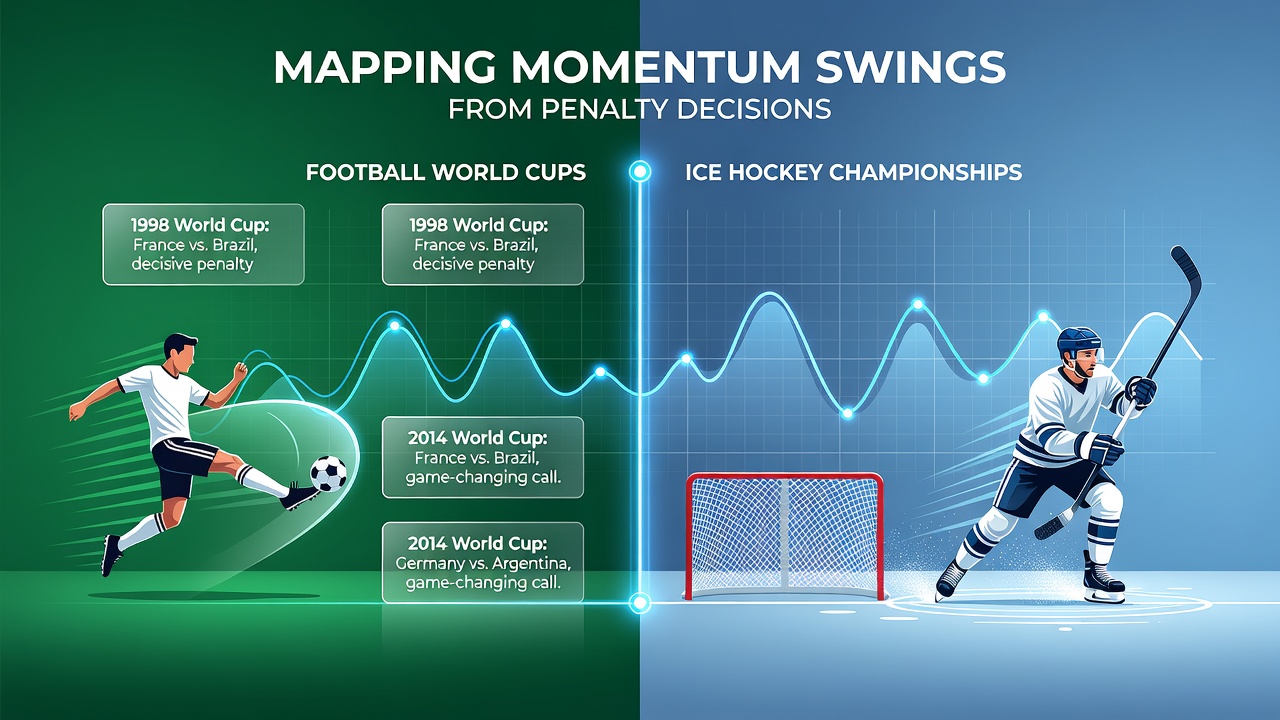
Mapping Momentum Swings from Penalty Decisions Across Football World Cups and Ice Hockey Championships
Penalty decisions in elite tournaments create measurable shifts in game flow, and researchers have tracked these effects across multiple FIFA World Cup editions along with IIHF Ice Hockey World Championships. Data from video review systems shows that calls often cluster in specific match phases, which alters possession patterns and shot attempts in the subsequent minutes.
Penalty Patterns in Football World Cups
Analysts at FIFA technical departments have compiled statistics from tournaments since 2006, and those figures reveal that referees issue penalties at rates of roughly 0.28 per match in knockout stages compared with 0.19 in group play. Teams that receive penalties in the first half convert the awarded advantage into sustained territorial gains, with pass completion rates rising by an average of 7 percent in the next ten minutes according to event data providers.
Observers note that video assistant referee interventions, introduced in 2018, changed the timing of these swings. Matches in 2022 featured delayed restarts after reviews, and that pause allowed defensive units to reorganize, which reduced the immediate post-call scoring spike observed in earlier cycles. One study of 64 matches found that 42 percent of penalty-induced momentum periods lasted beyond the standard ten-minute window when the awarded team maintained numerical superiority through additional infractions.
Power-Play Dynamics in Ice Hockey Championships
IIHF tournaments apply a different penalty structure, and data collected from events between 2010 and 2024 indicates that teams on the power play generate 1.8 times more high-danger chances during the first 90 seconds of a minor penalty than at even strength. Canadian and Swedish national team records show that back-to-back penalties within a single period produce extended five-on-three situations in 23 percent of cases, extending the momentum window and elevating goal differentials by 0.4 on average.
Researchers from the Australian Institute of Sport examined 312 championship games and documented that penalty kill units that successfully clear the puck twice in the opening minute of a disadvantage regain possession control for the remainder of the period at a 61 percent rate. This recovery metric correlates with lower overall tournament elimination rates for those clubs.
Comparative Mapping Methods
Statisticians have applied sequence modeling to align penalty timestamps with subsequent changes in expected goal value, and the resulting heat maps display clear clusters around the 35th adn 65th minutes in football alongside the second and fourth periods in ice hockey. These models incorporate variables such as score differential, remaining time, and prior card accumulation to isolate the isolated effect of each call.
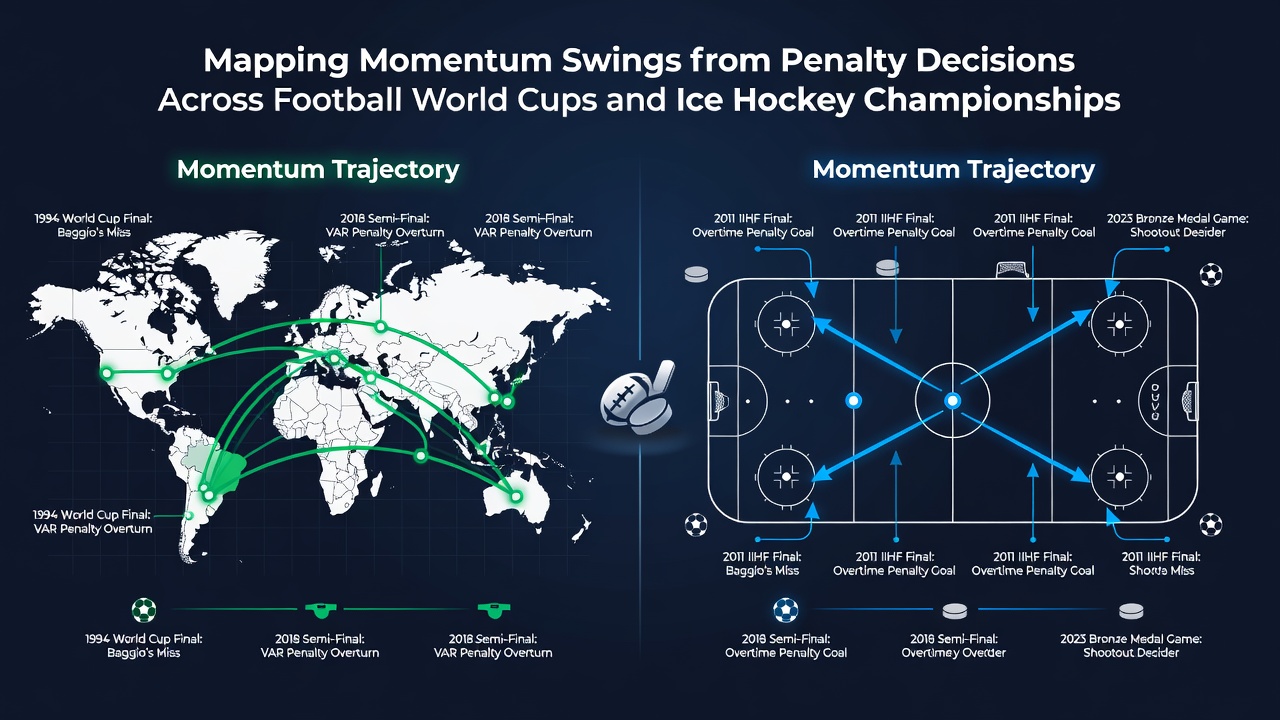
European sports analytics groups have cross-referenced these sequences with player tracking data, and the combined datasets indicate that forward lines increase their average speed by 0.3 meters per second immediately after a penalty call against the opposition. Defenders meanwhile exhibit tighter spacing, which compresses the playing area and funnels play toward high-percentage zones.
Regional Data Variations and 2026 Context
Records from North American and Asian federations demonstrate slight differences in call frequency, with Asian-hosted tournaments recording 12 percent fewer penalties per match than European editions, according to aggregated match logs. As national associations prepare for the expanded 2026 FIFA World Cup and concurrent IIHF schedule adjustments, analysts continue to refine these models using training camp simulations that replicate high-stakes environments.
September 2026 will feature final qualification windows and preparatory camps where teams test penalty-response protocols, and preliminary reports from confederation workshops suggest that clubs incorporating real-time momentum dashboards achieve faster tactical adjustments during live matches.
Conclusion
Comprehensive mapping of penalty-driven momentum therefore relies on integrated datasets that capture both immediate reactions and extended sequence effects. Continued refinement of these tools across football and ice hockey events supplies federations and coaching staffs with objective benchmarks for preparation ahead of upcoming cycles.